
AI Visibility Is a Data Engineering Problem
Most conversations about AI visibility stop at governance. Someone writes a policy, someone logs that an interface was hit, and the box gets checked. I have watched that comfort hold right up until an incident forces someone to answer a real question, and then it falls apart.
Here is the version I actually work from. AI visibility is a correlation problem you solve in the data layer.
Knowing the REST endpoint for list customers was called tells you almost nothing. You still need to know which customers were accessed, what query touched them, and what prompt set the whole thing in motion. Without that chain, you have a record that something happened and no record of what happened.
Push the Term Down a Level
"Visibility" is a slogan until you turn it into a specification an engineer can build. So let me hand you the spec.
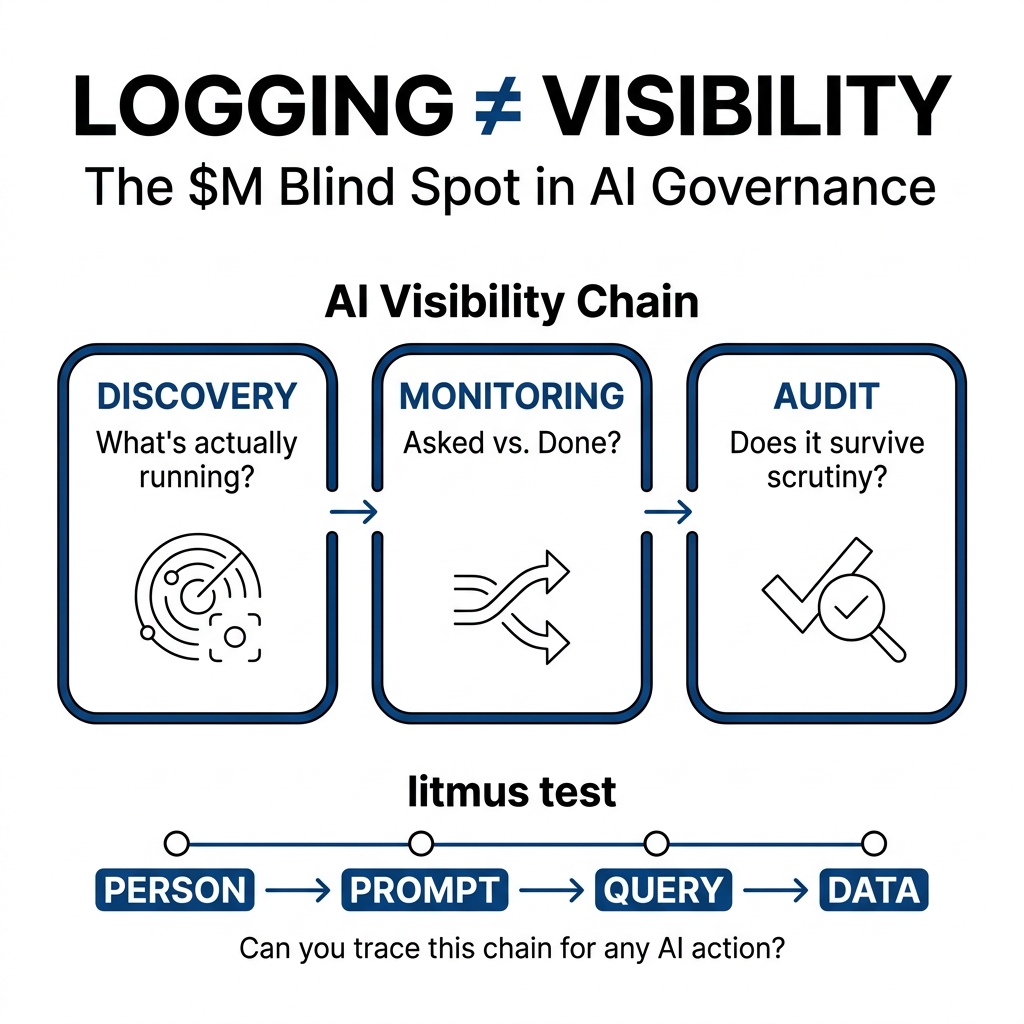
For any AI action, you should be able to reconstruct three things. The human who initiated it. The exact data it touched, down to the query. The intent that caused it, meaning the prompt.
That is the unit of truth. Anything short of it is expensive noise. I have seen systems generate far more signal than any team could ever act on, and volume without correlation just costs money and buys you nothing when you need answers.
Three Layers That Make It Operational
I break the work into discovery, monitoring, and audit. Each one answers a different question, and each one feeds the next.
Discovery: What Is Actually Running
You cannot instrument what you have not found. Discovery maps the AI tools and models operating inside your environment, including the ones nobody registered.
This is inventory work, and it is unglamorous. It is also where most programs are already blind. Shadow models and unsanctioned tools do not show up in a policy document.
Monitoring: Asked Versus Done
Monitoring watches the data flowing through those tools and captures what the system actually did.
The detail that matters most is the gap between what a user asked for and what the system executed on their behalf. A prompt requests one thing. The generated query does another. That gap is the thing worth watching, because it is where both mistakes and abuse live.
💡 If you can log the prompt but not the query it produced, you are monitoring intent without execution. That is half a picture, and the missing half is the part that touches your data.
Audit: Does the Record Survive Scrutiny
Audit is where I apply a simple test. Would this record hold up in front of an auditor, a regulator, or a court.
Most logging fails that test. It records surface events and loses the chain. Real audit means application-level telemetry and OpenTelemetry injection that ties the action to the initiator, the query, and the prompt in a form you can defend later.
The difference between clean traceability and a broken chain is whether a person closes their laptop and goes home, or spends the night reconstructing what a machine did on someone's behalf.
Why the Hard Part Stays Unsolved
Notice who benefits from calling this problem solved. Logging that an API was hit is cheap to sell and easy to demo. Reconstructing a full chain across prompt, query, and initiator is real engineering, and it does not fit neatly on a slide.
The incentive is to leave the hard part unsolved and price the easy part as if it were the whole thing. I refuse that framing. Compliance checkboxes are not observability, and I will not treat them as if they were.
Where This Lands for Your Team
If you lead a team that buys for engineers, the question to bring back is direct. For any AI action in your environment, can you name the person, the data, the query, and the prompt behind it. Then check whether that answer survives scrutiny.
The engineers already know where the gaps are. Discovery finds what runs. Monitoring captures asked versus done. Audit proves it later.
Build for the chain. Everything else is a record that something happened, with the important part missing.