
The Insider Threat Is Now Whoever Has the Widest Reach
I have spent most of my career walking backward through environments. Something happened, and my job was to reassemble it from whatever fragments were left behind. Half the time the fragment I needed had been filtered away, never generated, or was too shallow to prove what anyone actually meant.
That work taught me one habit I cannot turn off. When a category quietly expands, I stop looking at the center and go straight to the new edge. The edge is where the real story lives.
Insider risk just expanded its edge, and most programs are still guarding the old center.
Who Counts as a High-Risk Insider Changed Overnight
For years the answer was simple. The privileged few. Domain admins, database owners, the handful of people with keys to everything. You locked them down, audited their access, and slept a little better.
That model assumed access and capability were the same thing. Having read rights to the customer database only mattered if you knew you had them and knew how to use them.
AI severed that link.
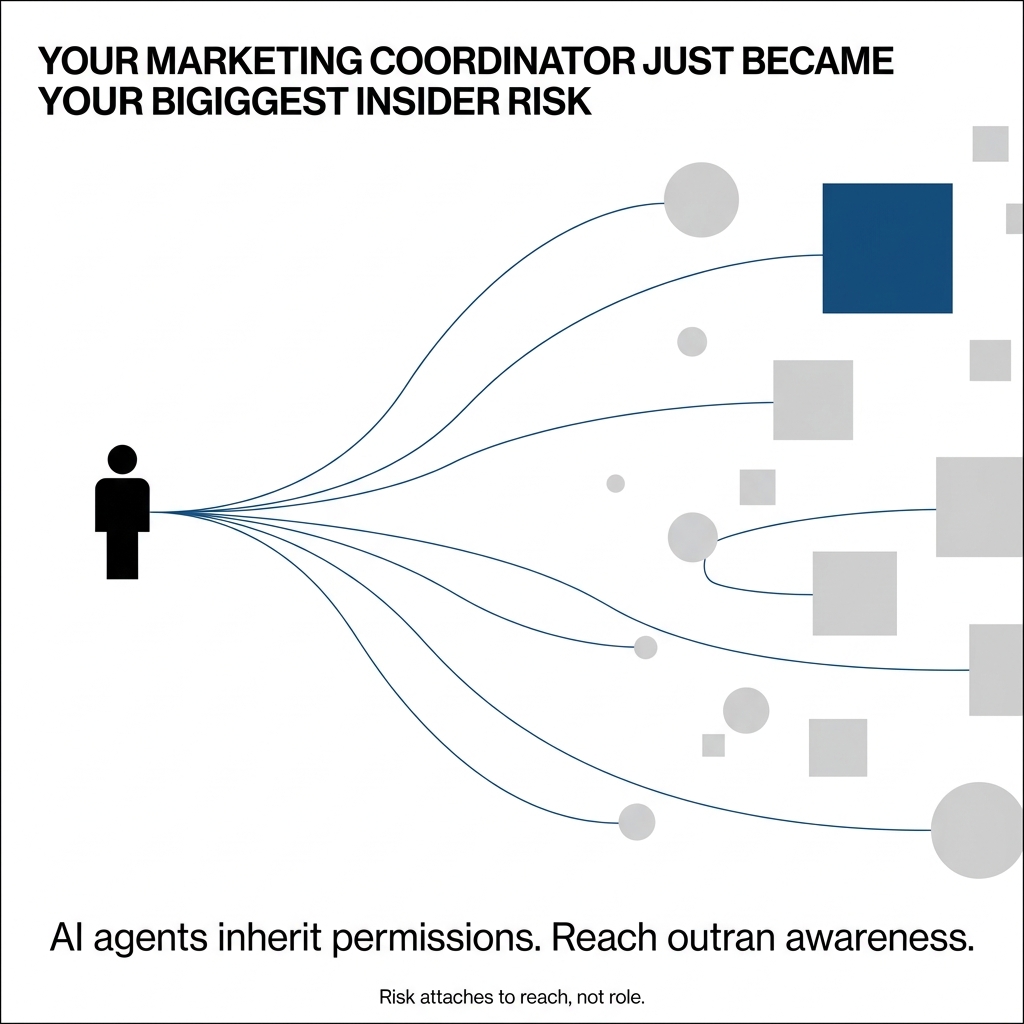
Think about a marketing coordinator who never once opened a database console. She did not know she had read access to customer records. She could not have queried it if she tried. Then her AI assistant, running with her exact permissions, found it for her and pulled it into a summary she asked for in plain language.
She became a high-risk insider without doing anything wrong. AI agents inherit employee permissions and surface data people never realized they could touch, including inherited permissions across HR files, executive communications, and client records.
Risk now attaches to the reach a person holds, not the role they occupy.
One Identity, Many Machines You May Not Own
Here is where my forensic reflex starts to ache.
Attribution used to mean tying a user to a machine. One person, one endpoint, one session to reconstruct. Now a single identity orchestrates activity across several systems at once, and some of those systems sit outside your control entirely.
An agent operating under one set of credentials across six integrated systems is six linked surfaces, connected by a decision layer that a few sentences of injected text can steer. Your UEBA baselines and DLP rules assume a human on the other end. The agent is not human.
So attribution of a user to a machine became attribution of a user to many machines. The unit you have to account for is no longer a person at a keyboard. It is an intent scattered across infrastructure, and reconstructing that intent is the whole job now.
The Evidence Problem Comes First
💡 The moment worth understanding already happened. The only question that matters afterward is whether anything durable was captured to reconstruct it.
Most of the time, no.
The logs you need to correlate machine action back to a single human intention can exist. Whether they were properly created and collected in most cases is a different matter, and the honest answer is that they were not.
I have hit that wall too many times to soften it. The signal existed. Someone filtered it out, sampled it down, or never turned it on, all before anyone thought to ask for it. Most enterprises still run disparate logging systems that leave visibility gaps no unified report can close.
⚠️ You cannot investigate an intent you never built the evidence to trace. Confidence about who did what depends on records you chose to create before the action, not after.
What I Would Do Before Scaling AI
I am not going to tell you to block agents in real time or slam the door on adoption. That is not the answer, and it never has been for capability that people genuinely need to do their work.
The framework I keep coming back to is discovery first, evidence second, everything else after.
- Map reach, not just roles. Inventory what each identity can actually touch through its AI tools, including the access nobody remembers granting through a casual OAuth approval.
- Build the record before you need it. Assume every consequential action will need reconstruction later. Generate and collect the telemetry that ties an action back to a human decision.
- Prize correlation over volume. Raw activity and raw alerting are noise. The rare correlated combination that reveals a single intent across many machines is the thing worth keeping.
Governing AI is an evidence problem before it is anything else. You earn the right to scale it by being able to reconstruct one human intention after the fact.
The insider is no longer the person with the title. It is the person whose reach outran everyone's understanding, including their own. And you only get to trust that reach if you built the record to trace it home.